
Reviewed · COOKING CLASSES
Balinese Ubud cooking school (9 Dish Cooking and Market Tour)
Come hungry, leave cooking. This Ubud experience combines a guided morning market visit, rice-paddy stop, and hands-on class in a Balinese home. I like the chance to prepare nine local dishes, not just one curry and a plate of rice. I also like that you eat what you make, with leftovers available to take away.
The main caution is the travel time. Pickup is arranged only in the Ubud area, and the cooking school can be about 50 minutes from central Ubud. The class is well organized, but some preparation is done before you arrive, so you will not handle every single step from market stall to finished plate.
In This Review
- Why this Ubud cooking class is worth considering
- From Ubud Palace to the morning market
- Rice paddies and a glimpse of village life
- Cooking in a Balinese home
- The regular menu: nine Balinese staples
- The vegetarian menu is a real alternative
- What the hands-on cooking is really like
- Lunch is the best part of the lesson
- Is $58 good value?
- Timing, transport, and group size
- Who should book this experience?
- Should you book the Subak cooking class?
- FAQ
- Where does the experience start?
- Where does the experience end?
- Is pickup included?
- How long does the experience last?
- Does every tour include a market visit?
- What does the morning option include besides cooking?
- What does the afternoon option include?
- Can I choose a vegetarian menu?
- How many dishes will I prepare?
- Is food included?
- Do I need prior cooking experience?
- How many people can join?
- Do I receive the recipes?
- Can I cancel for a full refund?
Why this Ubud cooking class is worth considering
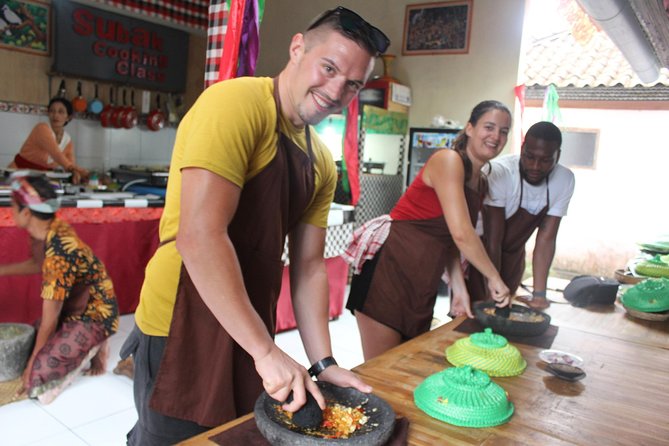
- Nine recipes in one class: Prepare Balinese soup, satay, lawar, sambal, dessert, and more.
- Morning market access: Shop for ingredients, sample unfamiliar fruits, and see local buying and selling.
- Rice-field context: Learn about Balinese rice growing and harvest timing during the morning option.
- Small maximum group: The class accepts up to 14 people, with individual cooking stations available.
- Regular or vegetarian menu: Both menus include nine main recipes and plenty of food to eat.
- Practical take-home value: You receive recipe copies, cooking guidance, and ideas you can use at home.
From Ubud Palace to the morning market
The meeting point is Ubud Palace, at the center of town. Pickup and drop-off are included within the Ubud area, but you should confirm the exact arrangement when booking. If you are staying outside Ubud, extra transport charges apply, and pickup is not automatically included unless requested.
Choose the morning class if the market matters to you. This is not just a quick stop for photographs. A local guide explains fruits, vegetables, spices, cakes, and the way people buy and sell food. You may also taste fruits and pastries that are unfamiliar if your daily diet is built around supermarkets.
The market gives the cooking lesson a useful beginning. Instead of seeing ingredients only after they have been chopped and placed in bowls, you get some sense of where Balinese cooks find them. You can also see flower offerings being assembled, which adds a cultural detail beyond the food itself.
The market is a working place, not a polished food hall. That is part of its appeal, but it can also feel crowded and noisy. Keep your expectations practical. You are there to learn how the market functions and recognize ingredients, not to receive a long formal lecture at every stall.
More Cooking Classes in Ubud
- Ubud Cooking Class Bali with Balinese Chef
★ 5.0 · 1,609 reviews - PRIVATE Authentic Balinese Cooking Class in Ubud at Putu’s Home
★ 5.0 · 644 reviews - Balinese Farm Cooking Class by Pemulan Bali
★ 5.0 · 410 reviews
Rice paddies and a glimpse of village life
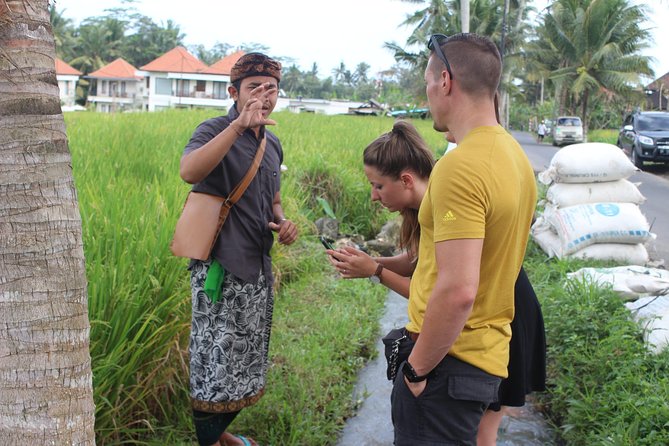
The morning program also includes a rice-field visit. Your guide explains how rice is grown in Bali, the different kinds of rice, and how long it takes to reach harvest.
This stop helps explain why rice appears with nearly every Balinese meal. It also gives you a short break between the market and the kitchen. Several people have especially enjoyed the views, including a mountain backdrop on clear days.
The visit is brief, but it adds useful context. You see that Balinese cooking is tied to farming, seasons, ceremonies, and household routines. If you want a full agricultural tour, this is not that. Think of it as a compact introduction before lunch.
The afternoon option follows a different pattern. It does not include the traditional market visit or rice-paddy stop. Instead, it includes making a Balinese offering. Check the time option carefully before you book, since the two programs are not interchangeable.
Cooking in a Balinese home
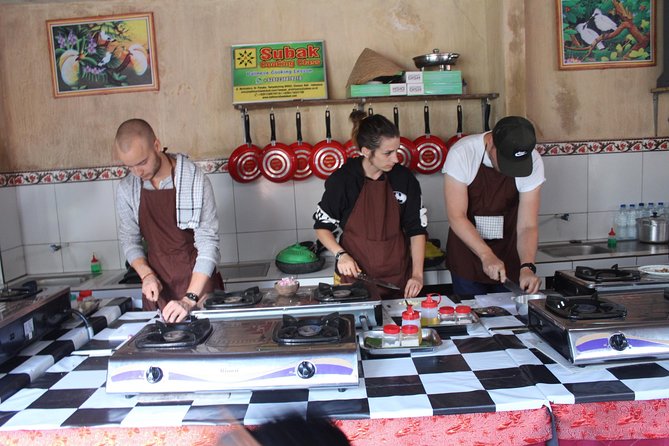
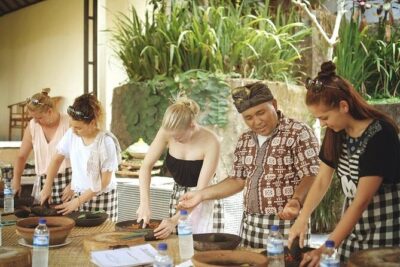
The cooking school operates in a local Balinese house adapted for classes. That setting gives the experience a more personal feel than a hotel demonstration kitchen. The space is organized for group cooking, with each pair working at a cooking station.
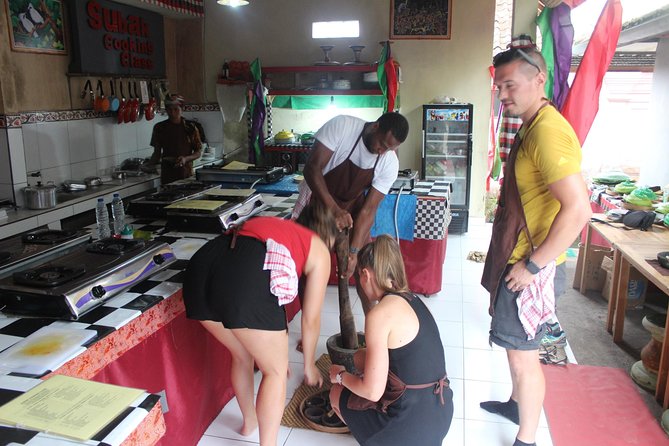
The maximum group size is 14 people. That is large enough to create a friendly shared meal, but small enough for the instructor and kitchen staff to move around and help. The class has been praised for having enough stations for everyone to take part.
Your instructor leads the class step by step. Instructors named in the experience include Yogi, Gus, Putu, and others, depending on the day. Their style is described as warm, funny, and clear, with English instruction available.
You will not begin with completely untouched ingredients. Much of the chopping and preparation is arranged in advance so the group can complete a long menu in about five hours. That keeps the class moving, but it also means you should not expect to spend the entire morning doing every bit of prep work.
This is a sensible tradeoff. Nine dishes require a lot of ingredients, and a class that made everyone start from zero would run much longer. You still take part in the important cooking stages, learn the spice combinations, and see how the dishes come together.
The regular menu: nine Balinese staples
The regular menu is designed to show several sides of Balinese food rather than repeating one preparation. All main dishes are served with white rice.
You prepare Sayur Bali, a Balinese vegetable soup. This is a useful introduction to the way vegetables and local spice mixtures work together in a simple broth.
The chicken dishes give the menu more depth. Ayam Santan Bumbu Bali is fried chicken finished with coconut milk and Balinese seasoning. Pepes Ayam is chicken cooked in a banana leaf, using grilling or steaming. The banana leaf adds fragrance and shows how traditional wrapping methods help cook and serve food.
Sate Lilit Bali is a Balinese-style chicken satay. Instead of simply threading chunks of meat onto a skewer, the mixture is shaped around the stick. This is one of the more distinctive dishes on the menu and a good technique to recreate at home.
You also make Lawar Bali, a mixed vegetable dish with Balinese spices. Lawar is valuable in a class because it teaches you how vegetables can carry bold seasoning rather than serving as a plain side dish.
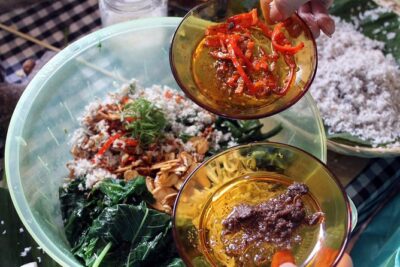
Sambal Matah is a raw spice mixture made with coconut oil. It brings fresh heat and sharpness to the meal. If you are sensitive to chili, tell the instructor before cooking. One useful feature of the class is that portions can be adjusted to suit different spice preferences.
Tempe Manis adds a sweet fried tempe dish. Tempe is made from fermented soybeans and is one of Indonesia’s most useful everyday foods. This preparation gives you a different flavor from the savory spice pastes and grilled dishes.
The class also teaches Base Gede, the basic Balinese spice paste. This is arguably the most valuable recipe to remember because it acts as a foundation for many Balinese dishes. Learn the texture, order of preparation, and balance of aromatics, then use it as a starting point for future meals.
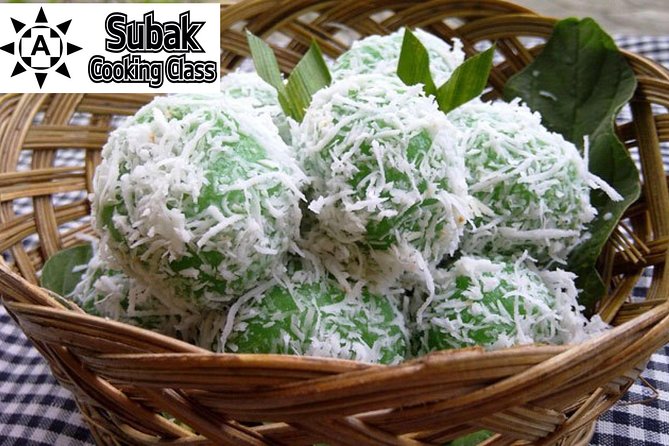
Dessert is Klepon, a boiled sticky-rice-flour ball filled with palm sugar. The small cakes are finished with coconut and offer a sweet ending after a strongly seasoned meal.
The menu is generous. You may be full before every dish has been sampled, so arriving hungry is practical advice, not a slogan. Any food left over can sometimes be packed for your hotel, although this depends on the day and the amount remaining.
Still Ubud, at a slower pace:
- All-Inclusive Ubud Private Tour
★ 5.0 · 14,344 reviews - Best of Ubud Full-Day Tour with Jungle Swing
★ 5.0 · 8,571 reviews - Ubud: Monkey Forest, Jungle Swing, Rice Terrace, and Water Temple
★ 5.0 · 7,160 reviews - Best of Ubud 1-Day Private Tour
★ 5.0 · 4,451 reviews
The vegetarian menu is a real alternative
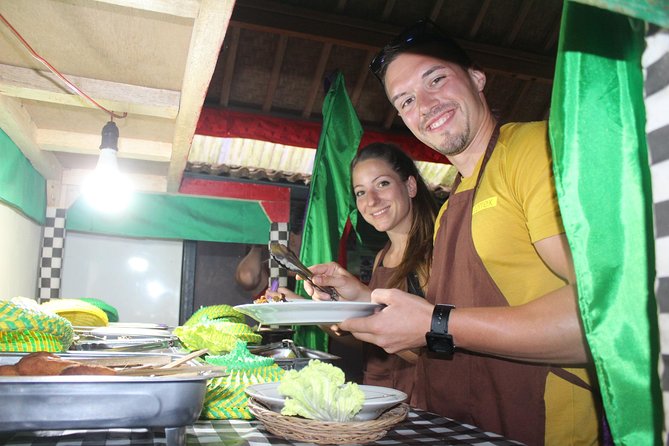
Vegetarians are not simply given rice and vegetables while everyone else cooks chicken. The vegetarian menu is planned as a full replacement.
You make Sayur Bali, Tempe Manis, Lawar Bali, Sambal Matah, Base Gede, and Klepon, just as on the regular menu. The meat dishes are replaced with:
- Tofu Bumbu Bali, fried tofu with the basic sauce
- Sate Tempeh with peanut sauce
- Pepes Tofu, tofu grilled or steamed in banana leaf
That gives you the same broad lesson in frying, wrapping, seasoning, skewering, and spice paste. Select regular or vegetarian when booking, and make sure the choice is clear before the class begins.
What the hands-on cooking is really like
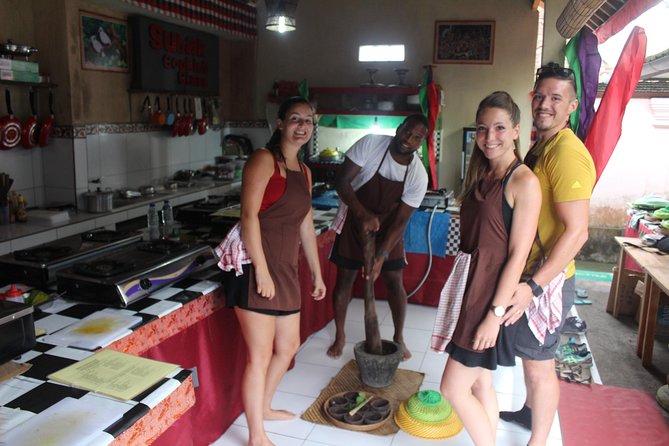
The class aims to keep you active without making the process stressful. You work with a partner, prepare the dishes under supervision, and cook at your own station. Kitchen staff help with the practical parts while the main instructor explains the techniques.
This format suits beginners. You do not need prior cooking experience, and the recipe copies give you something to refer to later. You will also learn about ingredients that may be difficult to find at home, along with equipment and cooking methods you may not normally use.
The experience is social. Several instructors are known for humor and easy conversation, and the shared table makes it simple to meet other people. English-speaking guidance is available, though the room can become noisy when staff are working and talking.
That noise is one of the few practical drawbacks. If you have trouble hearing in a busy room, stand close to the instructor during demonstrations. Ask questions as soon as they arise rather than waiting until the end.
The other point to understand is the balance between teaching and efficiency. Pre-prepared ingredients allow you to cook nine recipes in a half-day, but they reduce the amount of knife work and raw preparation you personally do. I would choose this class for learning flavor combinations and cooking methods, not for a slow farm-to-table preparation from scratch.
Lunch is the best part of the lesson
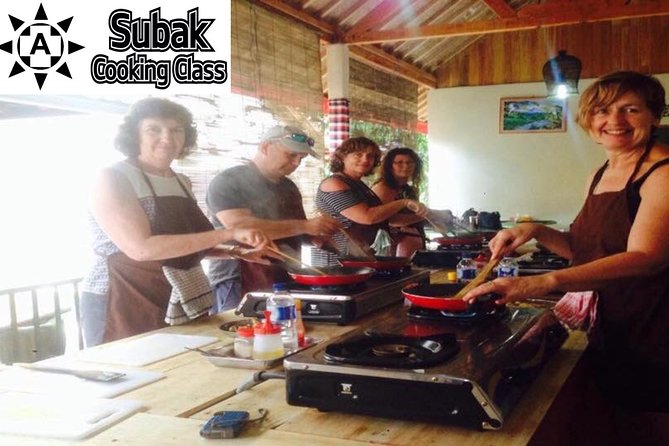
At the end, you sit down to eat the meal prepared by the group. Lunch or dinner is included, along with mineral water and food tasting during the class.
The meal is not an afterthought. You get to compare the finished dishes, notice how the spice paste appears in different recipes, and see how sweet, sour, hot, fresh, and creamy flavors work together. Because you cooked the food yourself, it is easier to remember the method.
The quantity is substantial. Some people find there is too much to finish, especially after tasting ingredients at the market. If you plan to take food back to your accommodation, bring that possibility into your schedule, but do not count on every dish being available for takeaway.
Alcoholic drinks are not included. Bottled water is provided, so you mainly need to budget for any extra transport cost and drinks beyond water.
Is $58 good value?
At the listed price of $58, the experience is not the cheapest cooking class in Bali. It is also more than a basic two or three-dish lesson. The value depends on how much of the full program you use.
You receive transport within Ubud, a guide or driver, the market visit on the morning option, a rice-paddy stop, kitchen equipment, mineral water, recipe copies, food tasting, and a large cooked meal. The class itself covers nine recipes, which makes the price easier to justify for anyone who wants practical instruction rather than a single demonstration.
A separate car, market guide, meal, and cooking class would quickly add up. The included transport is especially useful if you do not want to navigate rural roads yourself.
The price is less attractive if you are staying outside Ubud and must pay a substantial transport supplement. It is also less useful if you mainly want to eat rather than cook. You are paying for instruction, cultural stops, ingredients, staff, and a meal, not simply for lunch.
Before booking, confirm the current price and transport supplement for your hotel. The experience has sometimes been advertised at lower rates, but the stated price here is $58. Make your decision using the price shown at the time of booking.
Timing, transport, and group size
The full experience lasts about five hours. That includes transport, the market or offering activity, the rice-field visit when applicable, cooking, and the final meal.
The trip from central Ubud to the school can take about 50 minutes according to one detailed account. Traffic and the exact pickup point may affect the timing. This is important if you have a spa appointment, airport transfer, or another tour later in the day.
The official starting point is Ubud Palace, even though pickup is offered in the Ubud area. Bring your booking reservation and check the meeting instructions. If you are outside Ubud, request transport in advance and carry cash for any additional charge.
The maximum group is 14 people. Couples and friends are normally paired at a shared cooking table, and each person can still take part. For the most personal instruction, a smaller private class may suit you better, but this group format keeps the cost reasonable and the atmosphere lively.
Wear normal, comfortable clothing. Bring a camera if you want photographs at the market and rice fields. The supplied information does not call for special clothing or equipment.
Who should book this experience?
I would recommend it to food-focused visitors who want a full half-day rather than a short demonstration. It is particularly good for couples, families, friends, and first-time cooks who enjoy learning by doing.
It also suits people who want a small amount of culture with their meal. The market, rice fields, local house, and offering activity give the food a setting. You learn not only how to make sambal and spice paste, but also where ingredients enter everyday Balinese life.
Vegetarians have a strong reason to consider it because the alternative menu is extensive. Families can also benefit from the relaxed teaching style and the chance to cook together.
I would hesitate if you dislike long vehicle transfers, need a quiet classroom, or want every ingredient prepared from the beginning by your own hands. You should also skip the afternoon option if the traditional market is your main goal.
Should you book the Subak cooking class?
Book it if you want a generous menu, friendly instruction, and a useful look at local food culture in one outing. The market and rice-field stops make the morning program the better choice, while the cooking class itself is the main attraction in either time slot.
I would choose the morning tour, confirm pickup in writing, state your spice preference, and arrive ready for a large meal. At $58, it is a fair value when you use the market visit, transport, recipes, and nine-dish class. Just allow extra time for the drive and understand that some preparation is completed before you arrive.
FAQ
Where does the experience start?
The listed meeting point is Ubud Palace, at F7V7+72R, Jl. Raya Ubud No. 8, Ubud, Bali.
Where does the experience end?
The activity ends back at the meeting point.
Is pickup included?
Pickup and drop-off are included for locations in the Ubud area. Extra charges apply outside Ubud, and transport must be requested in advance.
How long does the experience last?
The experience lasts approximately five hours.
Does every tour include a market visit?
The traditional market visit is provided with the morning class only.
What does the morning option include besides cooking?
The morning option includes a local market visit and a rice-paddy visit.
What does the afternoon option include?
The afternoon option includes making a Balinese offering. It does not include the traditional market visit.
Can I choose a vegetarian menu?
Yes. You can choose either the regular menu or the vegetarian menu.
How many dishes will I prepare?
The class teaches nine Balinese recipes, with the exact menu based on whether you choose the regular or vegetarian option.
Is food included?
Yes. Food tasting, bottled water, and lunch or dinner made from the cooked dishes are included. Alcoholic drinks are not included.
Do I need prior cooking experience?
No prior experience is stated as necessary. The Balinese chef provides step-by-step guidance.
How many people can join?
The activity has a maximum of 14 participants.
Do I receive the recipes?
Yes. Copies of the recipes are provided to take away.
Can I cancel for a full refund?
You can cancel at least 24 hours before the local start time for a full refund. Cancellations or changes made less than 24 hours before the start time are not accepted for a refund.
More Shopping Tours in Ubud
- Active Volcano, Rice Field, Hot Spring, Fruit market, Tea Plantation with Lunch
★ 5.0 · 513 reviews - Yogyakarta Cooking Class and Market Tour
★ 5.0 · 99 reviews - Ubud Experience ; Swing, Waterfalls, Art Market, Rice Terrace
★ 5.0 · 56 reviews - Jakarta City Tour: Shopping & Culinary Experience
★ 4.5 · 15 reviews
More Market Visits in Ubud
- Balinese Cooking class with traditional morning market visit
★ 5.0 · 161 reviews - PRIVATE Ubud Market Tour & Balinese Cooking Class with Putu
★ 5.0 · 125 reviews - Ubud Cooking Class with Optional Market Visit Pickup Included
★ 5.0 · 70 reviews - Balinese Cooking Class with Traditional Market Tour
★ 5.0 · 66 reviews
Just added around Ubud
- 3 Days for the best of Ubud Private Tour★ 5.0 · 63 reviews
- Bali Amazing Cooking Class★ 5.0 · 63 reviews
- Private Mount Batur Sunset Trekking – All inclusive tour★ 5.0 · 63 reviews
- Private Full-Day Handara, Ulun Danu, Jatiluwih and Tanah Lot Tour★ 5.0 · 63 reviews
- Half-Day Tour: Uluwatu Temple and Kecak Fire Dance Show★ 5.0 · 63 reviews
- Bali Iconic Tour with Buffet Lunch and Attraction Tickets★ 5.0 · 66 reviews
- Ubud ATV Quad Bike and Snorkeling at Blue Lagoon Beach★ 5.0 · 64 reviews
- Full Day Private Guided Tour to Bali★ 5.0 · 65 reviews
Cooking Classes, compared.
PRIVATE Authentic Balinese Cooking Class in Ubud at Putu’s Home
Read our review →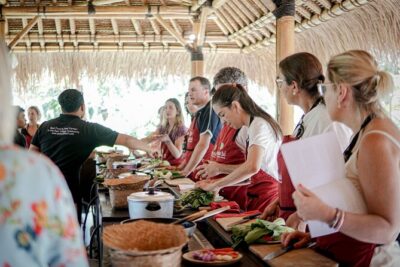
Learn to cook Indonesian food at Gili Cooking Classes Trawangan
Read our review →
PRIVATE Balinese Cooking Class in Ubud with Dewa with Transfers
Read our review →Browse the lists this tour appears in